
Perseverance Pays Off
Instead of rapid productivity increases after an agent is built, there's a dip where you need to invest in your agents to reap their rewards.

This is part five of a five-part series on how the companies seeing real returns on their AI investment are actually working.
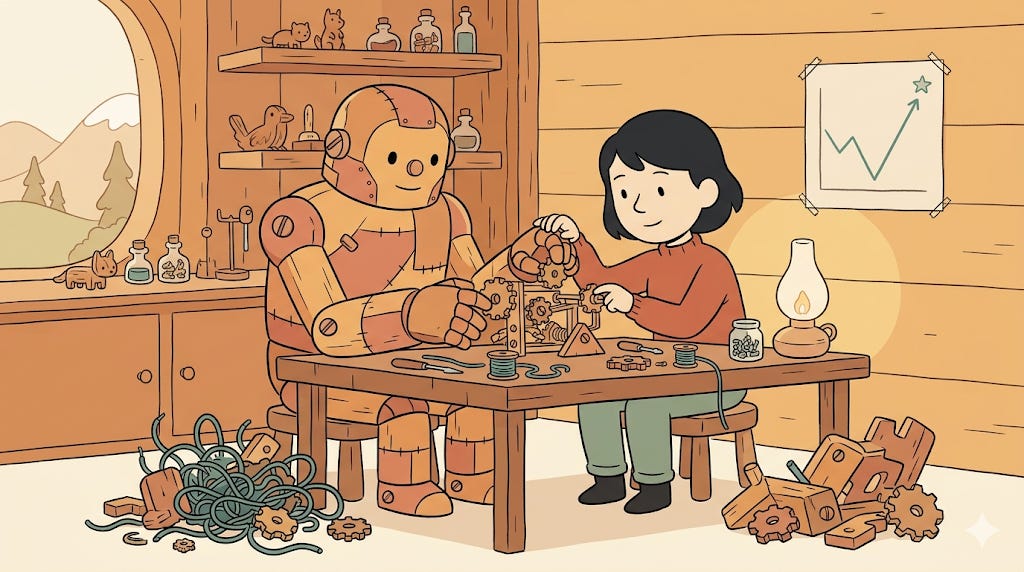
In part four we talked about how a small team can build and test something of real value in two days. This last piece is about what happens after that, in the weeks and months after what may have been described as a launch, when you feel the work is done. It’s about when you feel the pay off is not happening yet...
Earlier this year a group of researchers looked at tens of thousands of factories over four years to see what happened when they brought in AI. They were led by Kristina McElheran at the University of Toronto, with Erik Brynjolfsson at Stanford and people from the US Census Bureau. They found a clear pattern.
Companies that brought in AI usually got worse before they got better. Their output dipped first. Then, after a while, they pulled ahead of the companies that hadn’t bothered at all.
The reason is simple. AI isn’t something you switch on. It changes how work is done, and changing how work is done is by definition, disruptive. This was factory data, so you have to translate it to your own situation, whether that’s your own desk or your whole company. But this explanation of it matches what I’ve lived, and what I keep hearing from people who are really getting stuck into AI rather than just poking at it.
It describes a feeling most people recognize but can’t quite place. That odd spot between frustration and hope. You started using AI because you thought it would help. And it does help. But it takes longer than you expected, the first few weeks you’re elated, then your realize the results aren’t quite what you’d hoped. You work to make it better and then find that you’re spending as much time checking and fixing as you are getting anything done.
Upwork asked 2,500 people across four countries, half of them senior leaders, about this. Among the ones using AI, more than three quarters said it had added to their workload rather than taken work away. They were spending the time checking and correcting what it produced.
But when you step back, perhaps it is not unsurprising.
I keep thinking of it like hiring someone. When a new person joins, you put work in before you get anything back. You interview, you onboard, you explain how things are done here. Then they arrive, and for a while they’re learning, and they take up a real chunk of your time. You’re answering questions, training, giving context, explaining why things are the way they are. Your own output drops. For a stretch, the two of you together get less done than you did on your own.
That’s not a sign you hired the wrong person. It’s just what it takes to bring someone in who’ll be worth many times the effort later.
GenAI is the same. There’s the setting up: choosing the tools, plugging them into the things they need to know about, working out what’s worth telling them, learning how to ask, crafting prompts, adjusting workflows. There’s the early output, which comes back generic, misreads what you meant, and is sometimes confidently wrong. And there’s the checking, which everyone underestimates. But the people who stay with it are finding the effort pays back many times over, giving them not just speed but time for the work that actually matters.
McElheran’s team found that the companies that found the tenacity to stick with it pulled ahead. They adopted a similar approach to deploying AI solutions to how we’ve always been building software products. They recognized software is never done, they remembered that it moves through a lifecycle.
The first versions of the products we build are often very different to the ones that get used at scale, they’re rough and just good enough. The trick is sticking with it, and acknowledging it’s about working toward the right answer, not believing you’ll get there in the first iteration.
The ones that gave up? The numbers there are stark, though they come from a different study. S&P Global found that in 2025, 42 out of every hundred companies abandoned most of their AI projects, up from 17 the year before. The typical company scrapped close to half of what it had started before any of it delivered any real value.
Not because they were wrong about the problem they were solving, or even how they were using AI to solve it. Rather, it’s because they forgot one really important thing. AI is software, and software is never done, and not unlike the people we hire, onboard, invest in and promote - if done well they’ll deliver amazing results.
David Beath runs BuildFirst, where he helps organisations in regulated industries build with AI without losing their footing. He writes The AI Cookbook, notes from two months further along the trail. After a quiet stretch, he is writing again. If you are seeing your own version of this pattern inside your organisation, he would like to hear about it.